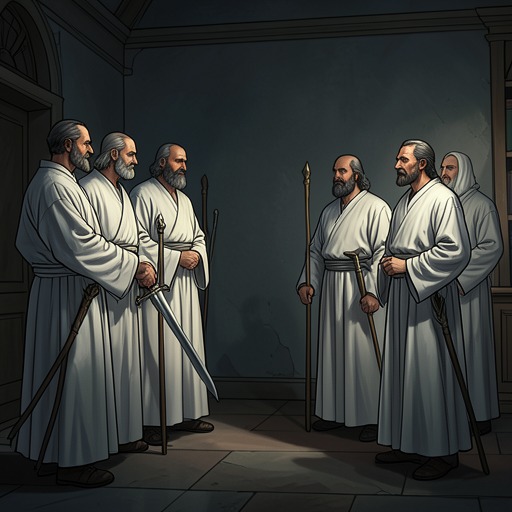
Erryk Cargyll
Fire & BloodErryk Cargyll was one of the Kingsguard whose loyalty divided with the royal family during the struggle between Rhaenyra Targaryen and Aegon II. While his twin brother Arryk was in King’s Landing, Erryk was with Rhaenyra on Dragonstone; the brothers’ opposing service ultimately brought them face to face as enemies, and both died from the encounter.
Identity and Allegiance
The Kingsguard was a sworn brotherhood of seven knights pledged to defend the king and his kin. At the time of King Viserys’s death, only five white cloaks were in King’s Landing. Erryk and Arryk, his twin, were elsewhere with Rhaenyra on Dragonstone, unaware of the nighttime summons that drew their brothers-in-arms into the political crisis. Erryk later stood with Rhaenyra at her black council alongside Ser Lorent Marbrand, marking his place among the princess’s supporters as the rival court took shape.
The Cargyll Twins’ Parting
Long after the Dance, Luceon of Tarth composed “Farewell, My Brother,” a ballad that presented the twins’ last meeting as a conscious farewell. In the song, Arryk and Erryk tried to persuade one another to change sides as Orwyle’s party boarded the ship from Dragonstone to King’s Landing. When neither yielded, they exchanged declarations of love and parted knowing that they would meet next as enemies. The ballad gives their political division the intimacy of a family parting: the choice of allegiance does not erase their bond, but makes that bond part of what the coming violence will destroy.
That poignant scene is not established fact. The account allows that such a farewell may have taken place, but none of the sources mentions it; its only attestation is the later song. The distinction matters because the Cargylls’ eventual encounter became a subject of competing accounts, with singers favoring a tragic narrative of brotherly love. Luceon’s ballad supplies an emotionally shaped prelude to their deaths, but the historical record leaves open whether the twins had any such parting at all.
The Duel on Dragonstone
Arryk reached Dragonstone disguised as a fisherman, then put on his armor and white cloak and entered the castle by passing himself off as Erryk. The deception brought him deep into the royal apartments, but there he met his twin, who immediately understood what his presence meant. Their shared face, once a means to deceive others, now made the encounter harder for the watching court to comprehend: no one present could tell which brother was which as they fought.
Grand Maester Munkun’s account makes the duel last nearly an hour. The clash of steel woke half the queen’s court, yet the onlookers could only watch helplessly. In this telling, the twins exchanged declarations of love before drawing their swords; each dealt the other a mortal wound, and they died in one another’s arms with tears on their cheeks. The drawn-out struggle and mutual embrace turn the brothers’ divided allegiance into a tragedy of recognition: each knows exactly whom he must fight, but neither can make that knowledge undo the conflict.
Mushroom’s version is shorter and more brutal. He rejects the loving words and has each twin denounce the other as a traitor. On the spiral steps, Erryk strikes first, cutting down at Arryk and nearly severing his sword arm at the shoulder. As Arryk falls, he seizes his brother’s white cloak and pulls him close enough to stab him in the belly. Arryk dies before the first guards arrive; Erryk survives for four days, screaming in pain and cursing his brother. The accounts disagree not only about the duel’s duration but about its emotional meaning: Munkun’s is a reciprocal death marked by love, while Mushroom’s is a brutal exchange of treachery and vengeance.
The sources offer no certain resolution. Singers and storytellers favor Munkun’s version, while Septon Eustace says only that the twins slew each other. The cautious record therefore preserves the duel’s outcome but not a definitive account of its final moments. The later ballad and the rival histories make Erryk’s death part of a larger pattern in the Dance: family bonds survive in memory and song, even as competing loyalties make kin kill kin.
The Kingsguard’s Divided Oath
Erryk’s part in the Dance exposes a contradiction at the heart of the white cloak: the Kingsguard swore to defend the king and his kin, yet the rival claims to the throne split that sworn brotherhood itself. Erryk’s service to Rhaenyra and Arryk’s to Aegon turned the brothers’ duty into opposing obligations. Their story therefore makes the succession conflict more than a contest between courts: it shows how a struggle over who should rule could make even the institution charged with protecting the royal family serve its members against one another.